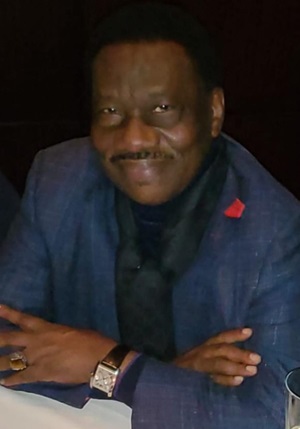
Professor Chalokwu is Professor Emeritus of Geochemistry and Physical Science at Saint Xavier University in Chicago, Illinois, USA, and president/CEO of Medical Assay Laboratory, Inc. He has received numerous recognitions for his work, including his induction as Fellow of GSA and of several other professional societies.
His support of the next generation of geoscientists as an academic and as an administrator is well known. One special example is the Christopher I. and Irene N. Chalokwu Travel Award for undergraduate or graduate student travel for students in Africa, working on any aspect of African geology, to attend and present their research at GSA’s annual meeting, GSA Connects.
Professor Chalokwu answered several questions that we had about his trajectory, his perspectives on geoscience and geoscientists, and the importance of developing and sharing African geoscience research. We are happy to share his answers with you.
What brought you from Nigeria to the U.S.?
I came to the U.S. 51 years ago as an international student on an F1 visa. I did all my schooling here in the U.S. from bachelor’s degree to postdoctoral studies.
What was your journey to discovering geoscience as a career?
I was born in Jos, Nigeria, a city informally known as Tin City because of major mining activities for tin and columbite. I remember visiting the mines in Jos as a young lad in elementary school, which sparked my interest in science. I also came of age when major oil fields were discovered in Nigeria by Shell-BP. I was primarily interested in mining or petroleum geology in my formative years as a student of geoscience. I do not know what happened along the way and I ended up in igneous petrology and geochemistry.
What are the inflection points in your career?
After obtaining a Ph.D. in geology and geochemistry from Miami University I landed a tenure-track position at Auburn University in 1984. I quickly rose through the ranks to full professorship and obtained a Fulbright Senior Fellowship to teach at the University of Ghana and conduct research at Fourah Bay College in Sierra Leone. These activities exposed me to the intricacies of African geology and the challenges faced by students and early career professionals working in Africa.
A major shift in my career trajectory occurred when I became a college dean and it occurred to me that I have a better chance of influencing a broader and considerable number of students through the curriculum than the limited number of geology students whose research work I may supervise. Becoming a vice chancellor at the University of Tennessee, a provost at Saint Xavier University, and an external examiner for universities in Africa gave me a broader picture of the higher education landscape in the U.S. and internationally. As an academic administrator, I became intrigued with the issues of student engagement and in the process developed an abiding interest in student success through the academic curriculum.
What advice do you have for Nigerian students interested in a career in science?
My advice for any student interested in a career in science is to approach science from an interdisciplinary perspective. I encourage students to develop a strong background in foundation courses in math, physics, chemistry, biology, earth science, and computer science. My advice is for Nigerian students who wish to study abroad to seek majors that have applied components instead of majoring in programs that are merely duplicative of programs elsewhere in Nigeria.
Why did you decide to contribute toward awards for African students to come to GSA Connects?
My goal is to provide an avenue for disseminating high-quality research by students in Africa and in the process bring African geology into focus for U.S. professionals. GSA is the premier geoscience society in the world and is uniquely ideal for fostering international scientific exchange and developing lasting linkages. My experience working in Africa is that few opportunities exist for students to travel abroad for meetings. The Chalokwu Travel Award for students in Africa is intended to remedy this situation and hopefully encourage others with similar interests to contribute to this and other student travel funds.
How can GSA support the further development of a vibrant geoscience community in Nigeria?
GSA can support a vibrant geoscience community in Nigeria by developing linkages with geoscience organizations in Nigeria. These geoscience organizations and GSA can jointly sponsor theme sessions at GSA Connects. It will be nice to develop reciprocity whereby U.S. geoscience students also attend conferences hosted by geoscience societies in Africa.
 Speaking of Geoscience
Dr. Chalokwu is a very hard working professor who has distinguished himself as prolific educator and as an administrator.