Contributed by Rudy Molinek, GSA Science Communication Fellow
If you’ve ever held or beheld a diamond, there’s a good chance it came from a kimberlite. Over 70% of the world’s diamonds are mined from these unique volcanic structures. But, scientists are still working to figure out how exactly kimberlites erupt from deep in Earth’s mantle to the surface.
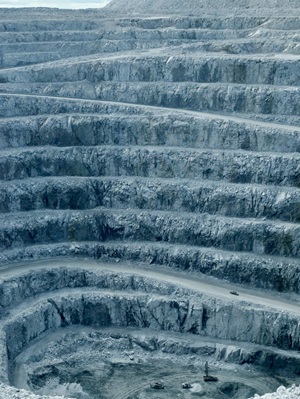
Kimberlites—carrot-shaped volcanic pipes that erupt from deep in Earth’s mantle—have a reputation among geologists as windows into the deep Earth. Their mantle-derived melt forms at depths greater than 150 km, and during eruptions the melt rises rapidly through the mantle and crust. Some estimates suggest ascent rates up to 80 miles per hour before kimberlites erupt violently at the surface. Along that journey, the magma picks up xenoliths and xenocrysts — chunks of the rocks encountered by the kimberlite melt.
“They’re very interesting and still very enigmatic rocks,” despite being well-studied, says Ana Anzulović, a doctoral research fellow at the University of Oslo’s Centre for Planetary Habitability.
In a study published this month in the journal Geology, Anzulović and a team of coauthors from the University of Oslo have made a big leap forward toward figuring out the enigmatic origins of kimberlites. By modelling how volatile compounds like carbon dioxide and water impact the buoyancy of the proto-kimberlite melt relative to surrounding materials, they’ve quantified for the first time what it takes to erupt a kimberlite.
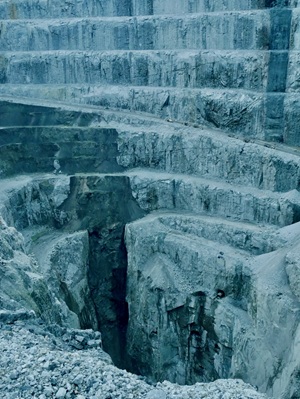
We know that part of the reason diamonds make it to the surface as part of kimberlites is because their rapid ascent prevents them from reverting to graphite, which is more stable at the pressures and temperatures in the shallow crust.But the composition of the kimberlite’s original melt and how they rise so fast has remained a mystery.
“They start off as something that we cannot measure directly,” says Anzulović. “So we don’t know what a proto-kimberlite, or parental, melt would be like. We know approximately but everything we know basically comes from the very altered rocks that get emplaced.”
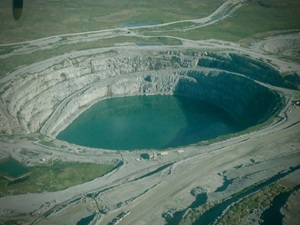
One big question for geologists interested in the origins of kimberlites and the composition of the mantle is how much of the parental melt is originally made up of volatile components like carbon dioxide and water. Anzulović and her team decided to find a minimum estimate by running models of how different original compositions would fare on their ascent. They based their work on the Jericho kimberlite, which erupted into the Slave craton of far northwest Canada.
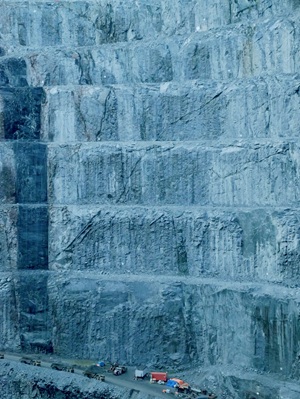
“Our idea was, well, let’s try to create a chemical model of a kimberlite, then vary CO2 and H2O,” says Anzulović. “Think of it as trying to sample a kimberlite as it ascends at different pressure and temperature points.”
Using molecular dynamics software that simulates atomic forces, the researchers calculated how atoms in a kimberlite melt will move, and then ran these simulations at different pressure and temperature conditions mimicking those of different depths. Figuring out the density of a kimberlite melt with those calculations, at each modelled depth, the researchers determined whether the kimberlite is buoyant enough to keep rising rapidly. They based their models on the Jericho kimberlite in far northwest Canada.
“The most important takeaway from this study is that we managed to constrain the amount of CO2 that you need in the Jericho kimberlite to successfully ascend through the Slave craton,” Anzulović says. “Our most volatile-rich composition can carry up to 44% of mantle peridotite, for example, to the surface, which is really an impressive number for such a low viscosity melt.”
They also found that the presence of water increases diffusivity of other elements in the melt, which means the kimberlite melt remains more fluid and mobile. Carbon dioxide, on the other hand, has a dual role. At higher pressures, CO2 can help polymerize melt structure. But at low pressures, near Earth’s surface, it tends to degas and propel the melt upwards — a needed boost to prevent getting stuck in the continental crust. The study found for the first time that the Jericho kimberlite needs at least 8.2% CO2, or else they’d never erupt, and thus diamonds would remain comfortably hidden away in the mantle.
Anzulović says the atomistic modelling approach, common to material science, chemistry, and physics, is showing promising results also in studies of geologic-scale processes.
“I was actually pretty surprised that I can take such a small scale system and actually observe, ‘Okay, if I don’t put any carbon in, this melt will be denser than the craton, so this will not erupt,’” she says. “It’s great that modeling kimberlite chemistry can have implications for such a large-scale process.”
 Speaking of Geoscience