Contributed by Jeanette M. deCuba, GSA Graduate Student Research Grant Recipient
On 20 April 2010, an explosion caused the discharge of approximately 172 to 206 million gallons of oil and gas into the Gulf of Mexico over 84 days. The Deepwater Horizon (DWH) oil spill is considered the largest deep-sea marine oil spill in human history. The offshore drill rig, which gave the event its name, was located in a submarine canyon known as the Mississippi Canyon. In response to this catastrophe, emergency measures were implemented, including the application of about 2.1 million gallons of dispersant to both the sea surface and wellhead.
Because oil and gas are less dense than seawater, some of the oil from the Macondo wellhead rose to the surface, while a portion moved laterally and became suspended in the water column. This material was eventually deposited onto the seafloor in the form of marine snow in an event known as the Marine Oil Snow Sedimentation and Flocculent Accumulation (MOSSFA). The spill resulted from poor judgment during well abandonment, compounded by BP and its associates’ negligence of safety practices and standard operations. The catastrophe severely injured several members of the DWH crew, and eleven rig workers were declared dead. In addition, the spill inflicted extensive economic and ecologic damage to coastal communities.
Benthic foraminifera are single-celled protists that live on the seafloor. They fall into two main categories based on their shell (test) type: calcareous and agglutinated. Calcareous benthic foraminifera construct their tests from calcium carbonate, while agglutinated foraminifera build theirs from the surrounding sediment. These organisms are very useful pollution indicators because they are sensitive to changes in their environment and can be collected in large quantities from a relatively small area. In the case of the DWH oil spill, changes seen in benthic foraminifera communities can be used to indicate changes in environmental conditions.
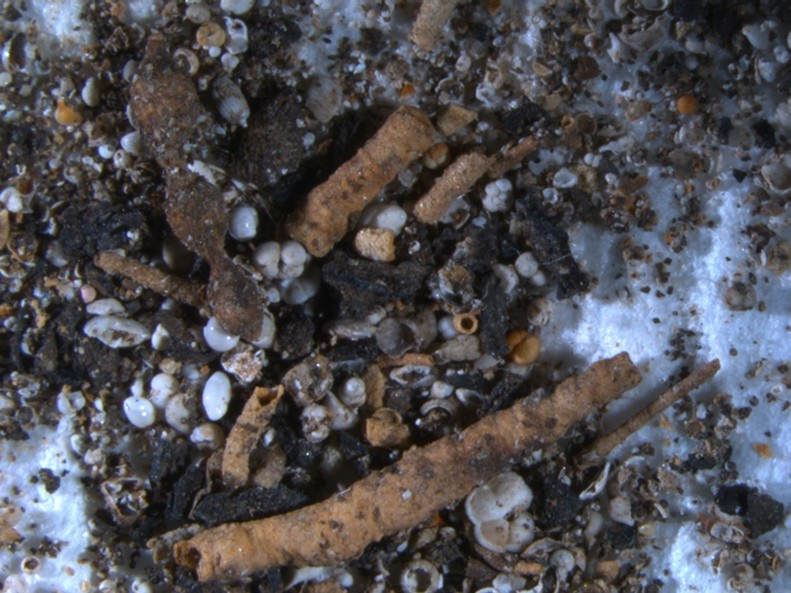
To investigate these changes, we used a core collected from the DeSoto Canyon during an expedition on the Florida Institute of Oceanography R/V Weatherbird II. Once we obtained our samples, benthic foraminifera were identified to the species level. We also quantified a dried, tarry material we call “dark particulate matter,” which was assumed to be part of the DWH oil spill due to its stratigraphic correlation with the spill in our sample core.
Our results reveal a distinct change in benthic foraminiferal community structure. For example, a shift in diversity (number of different species in a community), foraminiferal test type, and morphology is observed in the upper 2.5 centimeters of our sample core. This change in the benthic foraminifera faunal record coincides with a distinct change in sediment color observations as well as geochemical changes published in the literature on our sample core. Benthic foraminiferal taxa that contribute to this shift in community structure include tubular agglutinated foraminifera and some calcareous foraminifera belonging to opportunistic genera.
We attribute these shifts to a relatively large amount of organic matter deposited onto the seafloor in a very short amount of time and the initiation of low-oxygen conditions as a result of the breakdown of organic material. Therefore, this shift in benthic foraminiferal community structure was not solely caused by the large deep-sea oil spill but resulted from a combination of factors: the spill itself, response efforts, and feedback of natural physical, chemical and biological processes associated with the MOSSFA event.
Ultimately, we documented how benthic foraminifera responded to a short-term hydrocarbon pollution event and the concurrent to subsequent marine snow fallout. We hope to have provided a baseline for the development of benthic foraminifera as indicators of past, unidentified deep-sea oil spills and recovery efforts.

Jeanette is a second-year Ph.D. student at Binghamton University in upstate New York, where she works with Dr. Adriane Lam on reconstructing southeastern Indian Ocean water column conditions throughout interglacial-glacial cycles throughout the Pleistocene. Jeanette received a GSA Graduate Student Research Grant in 2022 to complete her master’s thesis at Florida International University in Miami. When Jeanette isn’t studying, she likes being outdoors (especially at the beach or on the water), hanging out with her dog, and traveling. Since moving to upstate New York from Florida, she also enjoys reading, sketching, and trying out new restaurants.
References
Kujawinski, E.B., Kido Soule, M.C., Valentine, D.L., Boysen, A.K., Longnecker, K., and Redmond, M.C., 2011, Fate of dispersants associated with the Deepwater Horizon oil spill: Environmental Science and Technology, v. 45, no. 4, p. 1298–1306, https://www.doi.org/10.1021/es103838p.
Larson, R.A., Brooks, G.R., Schwing, P., Holmes, C. W., Carter, S.R., and Hollander, D., 2018, High-resolution investigation of event driven sedimentation: Northeastern Gulf of Mexico: Anthropocene, v. 24, p. 40–50, https://doi.org/10.1016/j.ancene.2018.11.002.
National Commission on the BP Deepwater Horizon Oil Spill and Offshore Drilling, 2011, Deep Water: The Gulf Oil Disaster and the Future of Offshore Drilling: Washington, D.C., U.S. Government Publishing Office, 398 p.
Stout, S. A., and Payne, J. R., 2016, Macondo oil in deep-sea sediments: Part 1–Sub-sea weathering of oil deposited on the seafloor: Marine Pollution Bulletin, v. 111, no. 1–2, p. 365–380, https://doi.org/10.1016/j.marpolbul.2016.07.036.
 Speaking of Geoscience