Hello, fellow geo-enthusiasts! My name is Ava Healy, and I’m a current graduate student at the University of Massachusetts Amherst studying geographic information science and technology.
I have always been passionate about natural history museums and specifically paleontology. I basically grew up at the Harvard Natural History Museum—my family and I would visit every Sunday. This passion would lead me to an internship at the Museum of Comparative Zoology during the summer of 2022, where I worked with invertebrate paleontology specimens.
My ethos as a geoscientist focuses on equitable access to geoscience education, primarily through third spaces like natural history museums, libraries, and even the great outdoors! I love learning about the history and philosophy of geology, being able to use an anthropological lens to analyze hard physical science. Science needs to be more inclusive, gather more voices at the table, and be open to all. These learning environments are powerful third places for education beyond the classroom and at all ages. With diverse perspectives, opinions, and experiences, there will be immense potential to advance geoscience knowledge.
I embarked on a four-month research project of my own choosing in spring 2024. The project, titled “Who Started The Fire? The Discovery of the Podokesaurus holyokensis at MHC,” explored how the form of natural history collections reflect an institutional politics of memory and forgetting. Upon completing my research, I presented my findings at the Five College Undergraduate Anthropology Conference at Amherst College in mid-April of 2024. I was so overwhelmed that the panel, audience, and my fellow presenters had questions for me—all wanting to know more about the concept of museums and cabinets of curiosities. Even if I don’t remember the questions that were asked, I remember how their interest made me want to learn even more.
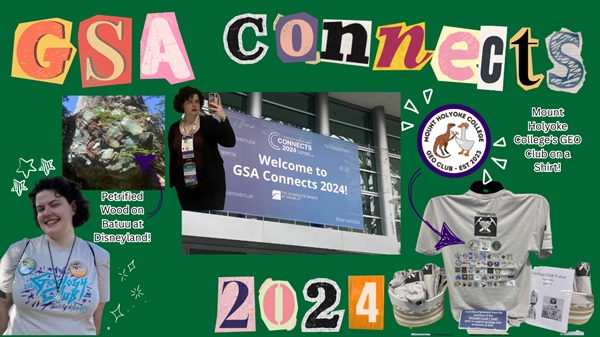
Last September, I attended GSA Connects 2024 in Anaheim, California, USA. I would not have been able to attend this event without the support of GSA’s On To the Future (OTF) program, as I had to miss a week of valuable work on top of having to support myself as a graduate student living on my own. Without the assistance from the stipend, there would have been no way for me to book a flight, secure accommodations, and feed myself for a week-long excursion. I really appreciated the support, and I know it means so much to so many young geoscience professionals.
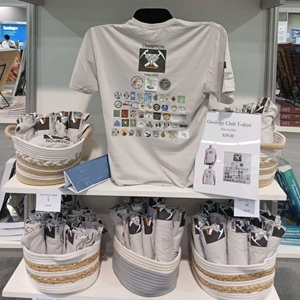
During the Geology Club Meet-Up at Connects, I was able to brainstorm and bounce ideas off members of clubs from all over the country. From “bad geology movie nights” to hikes focusing on geomorphology, I felt extremely inspired to know how much care and love there is for collegiate geoscience clubs. Mount Holyoke College, my alma mater, came in second place in GSA’s First Annual Tee-Off, and GSA made T-shirts that showcased all of the clubs that took part in the contest. These were available at the bookshop and donated a portion of proceeds to the geology club programs. It was lovely to see our logo and our hard work in print. I wear my shirt with pride and I know others do as well.
I spent hours in the Exhibit Hall, where I kept finding new booths every day. I spent most of my time at GSA’s headquarters area, exploring all the organizations and regional societies within it, and at the ESRI booth, where I got to learn about tons of opportunities for students just like me studying GIS. For example, their Young Professional Network and their Student Assistantships provide networking opportunities to build a community from all over the world. I quickly signed up. Now, I tell all my peers about the programs and opportunities I saw at the conference—I even encourage them to apply for OTF!
After I finish my Ph.D., I want to begin my career as a museum curator with the mission of integrating museum studies into high school and higher education. I have seen first hand the inspiration visitors and scholars alike gain from museums. I want to continue conducting free geoscience education research, working with library networks within the United States, where my work can have a direct impact on accessible programs for the whole country.
 Speaking of Geoscience