Contributed by Kemi Ashing-Giwa, GSA Graduate Student Research Grant Recipient
The Permian-Triassic (P-Tr) mass extinction (ca. 251.9 m.y.), resulted in the greatest animal biodiversity loss in Earth history. The geological trigger—the flood basalt eruptions resulting in the Siberian Traps, which raised global temperatures, acidified the oceans, and depleted ozone—is well agreed upon. However, the exact kill mechanisms of the extinction—warming, hypercapnia, ocean acidification, habitat loss, deoxygenation/anoxia, sulfide—have been hotly debated. Several lines of evidence suggest that the latest Permian oceans became anoxic, and potentially euxinic (anoxic with sulfide).
Few aerobic organisms are able to survive for long in environments with high levels of hydrogen sulfide, which inhibits cytochrome c oxidase, the last membrane-embedded enzyme in the cellular electron transport chain. Generally, it is understood that while anoxia alone is harmful for marine animal life, the impact of euxinia is even greater, with exposure to sulfide increasing hypoxia-driven mortality. However, there are clear differences in euxinia tolerance across marine species, especially those with significantly varied genomes and body plans.
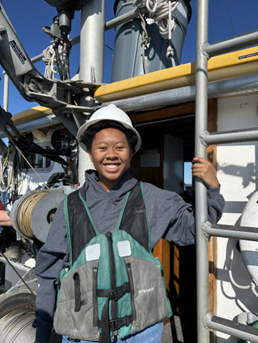
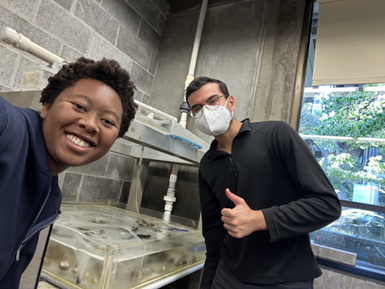
Hypotheses of sulfide as a primary kill mechanism are primarily based on the geochemical record and Earth system modeling, and there has been comparatively little consideration of physiology or selectivity in the paleontological record. As part of my Ph.D. work, I aim to test the physiological responses of one of the main “losers” of the P-Tr—articulate brachiopods—with two “winners”—bivalves and inarticulate lingulid brachiopods—in euxinic conditions.
During the summer of 2023, I began experiments at Friday Harbor Laboratories (FHL), San Juan Island, on T. transversa, an articulate brachiopod and G. septentrionalis, a bivalve clam. Specimens are placed in a modified flask filled with euxinic water, which is then placed into a recirculating water bath held at a constant temperature. Preliminary results have so far shown that articulate brachiopods cannot withstand sulfide nearly as well as bivalves, especially at higher temperatures, aligning with expectations given the latter’s comparative success. During these experiments, I observed what appeared to be different categories of behavior among the bivalves and brachiopods. At FHL this summer, with support from a GSA Graduate Student Research Grant, I will continue these experiments. I intend to observe the specimens more frequently and categorize the aforementioned behavior, paying particular attention to decreased or increased movement, gaping and speed of valve closure, and overall physical appearance.
So far, this study examines a limited number of species, and it is my goal to study more species collected from the same environment to minimize external variables. In addition to FHL, articulates and bivalve clams co-occur in New Zealand fjordlands, and inarticulates and articulates co-occur in Japan; physiological experiments on more species would provide additional statistical power to test my hypotheses.
Suggested Reading
Knoll, A.H., et al., 1996, Comparative Earth history and Late Permian mass extinction: Science, v. 273, no. 5274, https://doi.org/10.1126/science.273.5274.452.
Herman, E.K., and Kump, L.R., 2005, Biogeochemistry of microbial mats under Precambrian environmental conditions: A modelling study: Geobiology, v. 3, no. 2, https://doi.org/10.1111/j.1472-4669.2005.00048.x.
Grice, K., et al., 2005, Photic zone euxinia during the Permian–Triassic superanoxic event: Science, v. 307, no. 5710, https://doi.org/10.1126/science.110432.
Payne, J.L., and Clapham, M.E., 2012, End-Permian mass extinction in the oceans: An ancient analog for the twenty-first century?: Annual Review of Earth and Planetary Sciences, v. 40, https://doi.org/10.1146/annurev-earth-042711-105329.
 Speaking of Geoscience