Contributed by Taylor Rae Morrell, Ph.D. Candidate and 2023 GSA Graduate Student Research Grant Recipient
Geologists often have a different perspective of time and size scales. We nonchalantly toss around millions of years when discussing rocks and mountain systems. When we consider the thickness of continental crust, or deal with mm-wide minerals under a microscope, we tend to forget the scale on which people outside of geology work and think. Field work gives geologists the opportunity to combine research with travel and experience these different time and size scales in person. It also brings us out of our research and discipline bubbles to interact with nongeologists and explain to curious strangers why we are debating a roadside outcrop for 30 minutes!
As a graduate student, field work allows me the opportunity to immerse myself in the rocks and mountain systems I spent months reading about. Standing in front of an outcrop that you have travelled halfway around the world to observe prompts the science to jump off the page and become tangible. Departing from the office for a few weeks to trade sneakers for hiking boots reminds you how miniscule you are in the full geological history of the Earth. It can also make you feel physically small! I remember the first time I saw the snowy Himalayan peaks of northern Uttarakhand, India, peek through the clouds on the horizon as we drove north. I had to stare at the peaks for a few seconds to realize that they were not clouds!
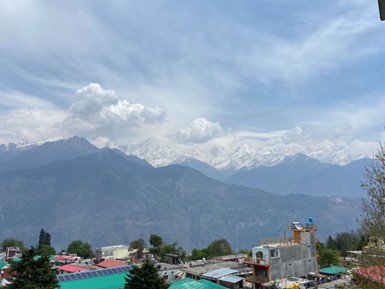
The Himalayan mountains are the result of the collision between the Indian and Asian plates ~50 m.y. ago. The mountains serve as a unique natural laboratory for my research to study the different processes involved in mountain building. The Himalaya offers a beautiful exposure of different rock types that stretch for over 2000 km. However, due to the stunning yet harsh environment, the Himalaya is often only considered from what is accessible to field geologists. Work along the length of the Himalayan system has shown that despite broad similarities, there are many differences along-strike. Such differences can include variations in magnitudes of seismicity and distribution of earthquakes, and differences in topography and ages of metamorphic rocks. The focus of my Ph.D. research explores the relationship between these along-strike variations with the possible reactivation of preexisting basement faults in the Indian plate beneath the Himalayan system. The Indian plate contains documented, much older basement structures that represent the extensive history of the Indian plate before the more recent collision with the Asian plate. The basement structures can be Precambrian sutures, shear zones, or normal faults bounding ridges. Can some of these inherited Indian basement faults account for distinct along-strike variations in the overlying Himalayan mountains on either side of the Indian basement faults?

My Ph.D. research in the Queen’s Tectonics Research Laboratory at Queen’s University in Canada specifically explores the differences in metamorphic grade and age along-strike in metamorphic cores of mountains, to highlight the possible signature of reactivation of the preexisting faults. My research involves field work focusing on structural geology and petrography, as well as quantitative lab work using accessory mineral petrochronology and metamorphic pressure-temperature modelling. One of the most exciting aspects of this research for me is the field work among snowy Himalayan peaks, exploring the Himalayan metamorphic core rocks in their natural exposure!
In 2023, I had the opportunity to conduct a 13-day trek through the Himalayan metamorphic core to collect samples and field observations. To complete field work safely and successfully, a field assistant was necessary. With the generous support of a GSA Graduate Student Research Grant, I was able to hire a field assistant to accompany me and offer field support. The ability to hire a field assistant by paying a competitive salary was essential to further the equity, diversity, and inclusion principles that both GSA and I aim to promote. Additionally, as a woman, it is an added benefit to have a field assistant that is also a female for field and travel safety. Having funding for a field assistant meant that applicants from different financial situations could apply and be considered, further preventing exclusion based on financial availability.

During the 100-km trek, we collected kilograms of rock samples to take back to the lab and visited countless outcrops along a river valley in northern Uttarakhand, India. These samples varied in rock type and metamorphic grade, including quartzite, garnet-biotite schist, migmatite, calc-silicate schist, orthogneiss, granite, and kyanite-biotite schist. We mapped shear sense indicators, major structures such as shear zones and faults, and different rock types. Quality field observations and oriented samples are essential for continued scientific rigour in research.
No field season is ever without detours or unplanned events. Our trek was supported by six mules carrying our camping equipment and rock samples. One night, after being let out to graze after a full day, the mules disappeared up the valley we were trekking in. It was over 24 hours until we saw the mules again! Field work forces you to be completely present in the moment, dealing with different emergent situations. The perspective change experienced during field work narrows from your full life at home, involving family, friends, pets, and work, to just your trek team and yourself, making sure that you are all safe, healthy, and collect quality data and samples!
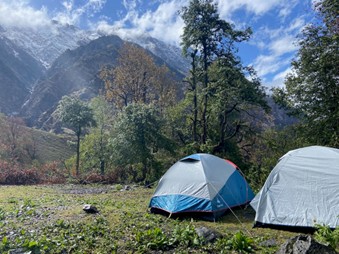
Working in a different country provided so many amazing opportunities for learning beyond geology. I was exposed to different customs, languages, religions, food, and how best to support the local population during field work. We had to be conscious of respectful sampling. I am incredibly grateful for the opportunity to travel and conduct field work in such a remote location.
Once home from the field, the work continues! I cut the samples into thin sections and conducted petrographic and microstructural observations. Strategic samples were selected for accessory mineral petrochronology to constrain the age of metamorphism. During the lab and office work, I enjoy reflecting on the field work and all the effort involved to collect these samples. Personally, conducting the field work keeps me grounded while sorting through data and writing my results. Perspective is an important aspect to consider during graduate school and a background as a geologist provides you with the essential skills to consider different time scales and size scales all within the context of a Ph.D. dissertation.

Taylor Rae Morrell is a third-year Ph.D. candidate at Queen’s University in Kingston, Ontario, Canada. Taylor received a GSA Graduate Student Research Grant in 2022 for a proposal titled “Tracking the Evidence of Reactivation of Basement Faults in Overlying Orogenic Systems: Structural Fieldwork in the northern Indian Himalaya.” She uses field mapping and data collection, structural methods (i.e., quartz crystallographic preferred orientation analysis and microstructural analysis), petrochronology, and metamorphic petrology to provide a multifaceted approach to her research. Born and raised in Canada, Taylor appreciates every opportunity to conduct field work, whether at home in the North American Cordillera, the Grenville Province, or worldwide such as in the northeastern Indian Himalaya.
 Speaking of Geoscience