Contributed by Robin Carbaugh, GSA Graduate Student Research Grant Recipient
The North Slope of Alaska is one of the harshest environments on Earth, with winter temperatures dropping to -50°F. Yet, life persists, providing a home to countless animals, including brown, black, and polar bears, moose, caribou, wolves, muskoxen, arctic foxes, and more. The landscape features some of the most fulfilling and breathtaking views, ranging from mountain ranges and tundra with permafrost polygons to the Arctic coastal ocean. Most of the land remains untouched by people, with limited infrastructure and few roads for those who brave the conditions. However, Northern Alaska did not always look this way. Approximately 200 million years ago, the region was an ocean.

My research focuses on rocks whose composition represents remnants of this ancient ocean. These rocks were deposited across the Triassic-Jurassic (T-J) boundary during the Triassic extinction event. The end-Triassic mass extinction, one of the “Big Five” mass extinction events, was triggered by a massive volcanic event known as the Central Atlantic Magmatic Province (CAMP) flood basalt volcanism. This volcanism is credited with driving the breakup of the supercontinent Pangea and causing widespread environmental changes, including global warming, ocean acidification, and low-oxygen oceanic conditions. Greenhouse gas emissions from CAMP volcanism left a strong carbon isotope record globally, now preserved in the rock record. My research involves analyzing rocks from the North Slope for these isotope excursions, as data on the T-J boundary is limited in Alaska.

A shift from well-oxygenated to low-oxygen waters occurred across the T-J boundary. These fluctuations in oxygen levels influenced fossil biodiversity and size, as well as the deposition of laminated dark mudstones and fossil-rich limestone. Low-oxygen events place significant stress on ecosystems, often leading to mass mortality, habitat loss, and reduced biodiversity. Ocean acidification, along with the stress on calcite-bearing organisms, is documented both across the T-J boundary and in the present day. Human-induced carbon emissions are currently causing environmental changes similar to those of the Triassic-Jurassic extinction event. Studying ancient climate change is crucial because evidence from the end-Triassic extinction can help us better understand modern processes.
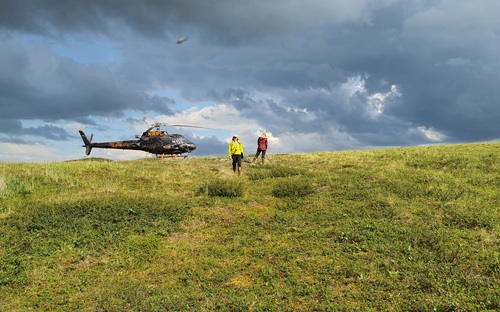
To collect samples for my research, I conducted helicopter-based fieldwork in the summer of 2022 on the North Slope of Alaska. Samples were collected at intervals and analyzed for carbon isotopes, fossil types, and fossil density. Thin sections of the samples were prepared and examined under a scanning electron microscope. The T-J boundary was identified by a shift in rock type, from fossil-rich to nearly void of life, indicative of a mass extinction event. Specific minerals, such as pyrite framboids, were observed. Pyrite framboids, which only form in low-oxygen environments, were found exclusively after the extinction event. These framboids are extremely small and require a powerful scanning electron microscope for observation. Carbon isotope data also signaled the location of the T-J boundary. Together, this evidence tells the story of the dramatic changes caused by the mass extinction event.
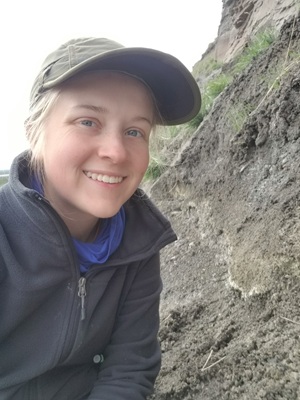
Robin Carbaugh is a Master’s student in Geoscience at the University of Alaska Fairbanks, with Dr. Michael Whalen as her thesis advisor. Robin received a Geological Society of America (GSA) Graduate Student Research Grant in 2023 for her project titled “Identifying the Triassic-Jurassic Boundary in Northern Alaska Using Carbon Isotope Excursions.” She also received an American Association of Petroleum Geologists (AAPG) Grant in 2023. Robin has lived in Alaska since 2021 and has conducted multiple field projects on the North Slope. She plans to continue pursuing research limited in data.
 Speaking of Geoscience