Contributed by Kai Tawil-Morsink, GSA Graduate Student Research Grant Recipient
About 94 million years ago, the oxygen content of the ocean declined, culminating in an “ocean anoxic event” (OAE) labeled OAE2 by scientists. Some sediments deposited on the seafloor during OAE2 have elevated organic matter content, attesting to a water column deprived of oxygen. Scientists study seafloor sediments in order to reconstruct past climate events like these, and I am interested particularly in seafloor sediments from OAE2. However, it is not necessarily easy to access sediments from the right time and location. Much of the rock I want to study is still at the bottom of the ocean!
Luckily for researchers like me, almost six decades of scientific ocean drilling projects (called, in succession, the Deep Sea Drilling Project, Ocean Drilling Project, Integrated Ocean Drilling Program, and today the International Ocean Discovery Program) have criss-crossed much of the globe and drilled rock from hundreds of seafloor sites. That rock is now kept available to scientists in repositories around the world.
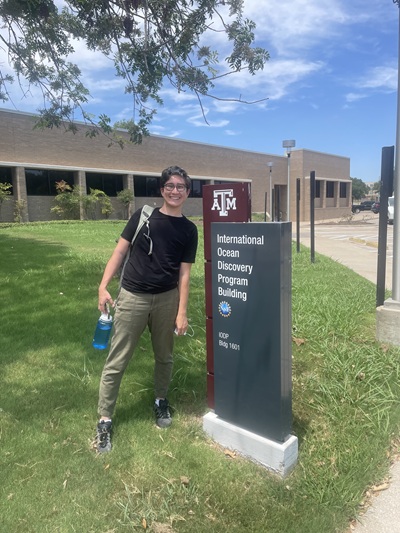
One of those repositories—the International Ocean Discovery Program Gulf Coast Repository (IODP GCR)—is located on the campus of Texas A&M University, on ancestral Tonkawa land (Tonkawa Tribe, 2024). In 2023, I received a GSA Graduate Student Grant to visit the GCR and observe and sample cores for my master’s thesis on OAE2.
It is very hot outside in Texas in August. The weather app reports daily highs around 110 °F (43 °C), which does not stop groups of new Texas A&M students from traversing the sidewalks, wearing lanyards and sometimes blazers. Since I have never before been in Texas, I solemnly note cultural differences: lots of people wearing polos, lots of college spirit apparel in the local Target, lots of “sir” and “ma’am.” I am transgender, and my appearance sometimes causes people to call me “sir” and sometimes “ma’am.” When called “ma’am,” I hesitate to correct people; a recent state-by-state breakdown of risk to trans people (based on laws passed) puts Texas into the “worst active anti-trans laws” category, and this part of the state is not known for liberal attitudes (Reed, 2023).
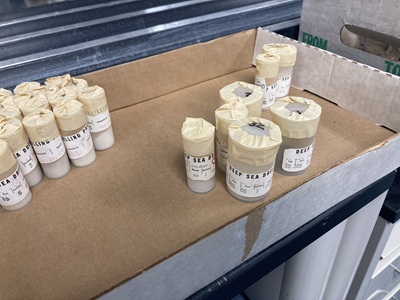
Happily for me, I spend most of my visit tucked away in the cool workroom of the GCR, assisted by fellow graduate student Hannah Robutka. At the GCR and other repositories, rocks are stored in the same form they were drilled from the seafloor. “Cores,” cylinders of rock usually 6 cm in diameter, are sliced down the middle and into 1.5-m sections. These cores are stored in towering racks of long plastic tubes (“D-tubes”) inside cavernous refrigerated rooms. Of the nearly 500 km of core belonging to IODP, the GCR houses 152 km, including most of the cores from the Pacific Ocean (IODP, 2024), where my master’s thesis research is focused.
For the rest of Kai’s story, read his article in GSA Today here!
 Speaking of Geoscience