By Laura Fattaruso, GSA Science Communication Fellow
Started in 2013, the Geological Society of America’s On To the Future program supports students from diverse communities to attend the annual GSA Connects meeting, by offering travel support, waiving registration and membership fees, and providing mentorship and specialized programming with GSA leadership. Ten years after the program was created, I spoke with two On To the Future program alumni who have become leaders within the geoscience community. Dr. Ángel García Jr. is the current chair of GSA’s Diversity in Geosciences Committee until June 30, when David Davis will take over as chair for the next year.
Here is a link to Episode 36 of my Lab Talk with Laura podcast, in which Ángel and David discuss their research, their first time attending the GSA Connects meeting as On To the Future scholars, and their visions for how to enact ongoing change and progress in the geoscience community. Below is a written transcript of the episode. I hope you enjoy it!
###
*opening jingle*
Lab talk with Laura. Listen, I implore ya. Won’t never bore ya. Lab talk with Laura Always more in store. It’s Lab talk with Laura.
Laura Fattaruso
Welcome to the 36th episode of Lab Talk with Laura. I’m joined today by my co-host, Sean Calhoun, and my guests, Dr. Ángel A. García Jr. and David Davis. Ángel is an Assistant Professor in the Department of Geology and Environmental Science at James Madison University. He is also the current chair of the Diversity in the Geoscience committee at GSA, until June 30. He’s a Boricua, Puerto Rican, and he obtained his PhD in Geological Sciences from Arizona State University in 2018. He’s a geologist interested in the intersection between place theory and communities to inform ethnogeology and other multi-disciplinary research, often using caves and other karst features as a central theme. David Davis is the incoming Chair of GSA’s Diversity Committee, and he’s from Merced, California, but calls Atlanta home now. He got his Bachelor’s of Science from Georgia State University Geoscience program in 2020, and he’s currently a PhD student at Rutgers University, where he studies the influences of salt-loving microbes, known as halophiles, on salt precipitation. Thank you so much for joining me, David and Ángel.

David Davis
Thank you.
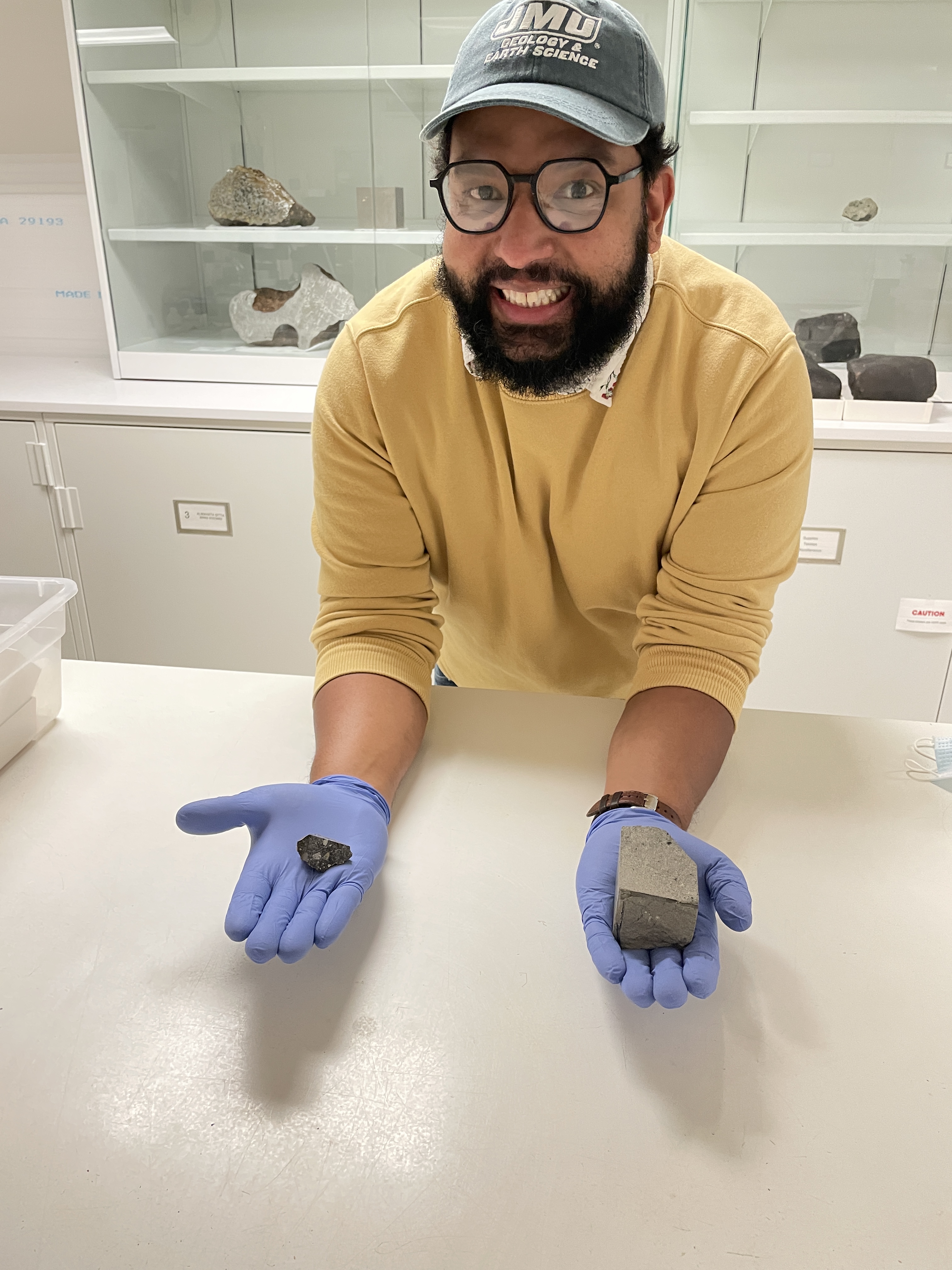
Dr. Ángel García Jr.
Thank you for inviting me.
Laura Fattaruso
Great, so to get started, I think maybe since you’re the current chair of the Diversity Committee, and we’re here to also talk about the On To the Futures Program (OTF), which both of you have been alumni of. Ángel, could you maybe tell me about your experience as the diversity chair this past year and some of the things that you’ve been working on? And, you know, what you’ve been up to, I guess, in that role?
Dr. Ángel García Jr.
Yeah. I will start with not how much I have done, but now that I’m almost at the end of my term, I was reflecting the other day, how much you want to do, but you don’t have time to do. Let me start with that. It is really, it’s a little bit challenging to make an impact as you want when you have a job, right, and this requires a lot of time. Getting into this position was such a privilege for me, right, because I’ve participated in many parts of GSA. But now I’m getting into the chair, I was able to manage many things. I think one of the things that I learned is this type of work is not done by just working really hard by yourself. It is done by working really hard with others, right? And working with others is not just like another task, it’s not just dividing of pieces to conquer. It is more like tackling really big chunks that needed to be tackled, but at the same time, right. So, one big thing is multiple big things that everybody’s tackling at the same time. So it’s been really, really, really good for me, really rewarding. I’ve met a lot of people. I’ve been in a lot of meetings. I’ve shaken a lot of hands. I collaborate in many, many things. And it’s been really good.
Laura Fattaruso
Awesome. So have you and David, have you been talking to each other about, kind of, this transition where you’re coming in to be the chair of the committee? Has that been a conversation?
Dr. Ángel García Jr.
Yeah, um, and I will speak, David, a little bit of our conversation. I think some of the thing that’s how I got into this position is also, like I was mentioning, I’ve been part of many stages of this whole family of programs, right. I was an OTF student, then I became an OTF mentor. And then I started randomly showing up to the Diversity in the Geosciences committee meetings, right. I was selected to be a member at large. And when they asked me, if I wanted to be part of that, you know, the chair, it seems logical at the time and still do, that I was getting into that position.
So, really similar happened with David, because you have a more holistic understanding, right, when you are in a position like this, that how other parts that you’re serving are going to be getting, you know, benefits from it, right? We just not revise proposals, we just not revised scholarships, or things like that, but we’re trying to make an impact and we know what’s on the other side of making that decision. I will say things are getting more, more, I will say, there are more resources available. And I should not share too much information, because this could ruin some things. But our job in order to be part of previous stuff, right, and now being part of the other side, each side of the coin. It is a unique perspective. And, and that’s how I approached David, like, you’ve been part of this since you’re an undergrad. Right. And you’ve been transitioning. And I think you will be an excellent asset into this committee. And I will let David talk because I had been talking too much.
David Davis
Yeah, that, you know, so it was actually last year Ángel and I had great conversations at last year’s GSA meeting in Denver. And the funny thing is, it was I, I guess I was a OTF in 2016. And I was an undergrad at the time. And I’ve been coming back, and you know, back from time to time to GSA meetings to present research but also to take part in the OTF workshops that were that were provided for OTF alumni. But also, I served, I applied to be on the, I nominated myself to be on the committee, I think it was 2019 I believe, and
Sean Calhoun
They just let you do that? You can nominate yourself?
David Davis
Yeah, you can nominate yourself. Yeah, well, because the thing is, at the time, I didn’t know anyone, you know, I was and to be honest, I was an undergrad, but I knew I wanted to be on this committee. So, you know, there was a PhD student in my lab and I was like “Hey, dude, nominate me for this committee.” He’s like, “What committee?” I’m like the Diversity Committee. He’s like, aah, you know, he didn’t care. And then, you know, so then—he’s probably gonna watch this, he’s probably gonna text me – anyway. But, uh, you know, so anyway, so I was like, you know, I’ll just nominate myself. And so I nominate myself. I didn’t get it the first time. And then the second time I nominated myself, when there was another opening. I made the point that I felt like I could, that I have experiences and a voice and a vision for GSA that is needed because I mean, you know, there aren’t that many Black people in geology, in geosciences and, and I didn’t… and that was basically the argument I made like, I felt like I should be on that committee. So I eventually got on the committee.
But last year, as I was, I think I had a similar realization that Ángel had last year during the committee meeting at GSA. I was sitting there thinking, like, you know what, there’s so much more I wanted to do on this committee. And so I asked Ángel, like, hey man, is there a way that I can do more? He’s like, oh, yeah, he’s like, well maybe you should consider becoming the chair. And I was like, oh, man, you know, so…
<laughter>
Sean Calhoun
Have you considered running the whole damn thing, if you wanna help?
David Davis
Exactly. So, and, and I was like, Yeah, I’ll think about that. When I said I’ll think about that, I don’t know if I was actually that serious. And then, and this is really funny, because I thought about it literally all day. And then that evening, we had a, we had a diversity reception. And on my way up to the reception, I got in the elevator, and I told Ángel this, and we kind of had a laugh. But on my way up to the reception, I got in the elevator, and this couple gets in, and they’re like, “Oh, are you? Are you the DJ?” I’m like, “No. Do I look like a DJ?” Like, I’m dressed really well, you know, I mean, like, badge, GSA, science, geology, same as you, dude. You know? And anyway, so when I got off the elevator, I was like, yeah, maybe that was a sign. Maybe I should do this. And then I saw Ángel sitting at the table, and I was like, yep, I think I’ll do it man. Yeah.
Dr. Ángel García Jr.
I want to add something, two things. It is funny, showing up randomly to meetings or nominating yourself. But sometimes it takes that to start making change, like to out of the blue doing things, instead of waiting for people to recognize you or to invite you right to the spaces. So you know, the thing that I want to say it is, so that terms get constrained into time limits, so the only way to keep David in the committee was that he is a chair, because if not, he needs to stop. I mean, you cannot be more than two years, I believe, a member at-large.
David Davis
Yeah, but for me, it was it was like three years. Yeah, it was three years. Actually, it might have been a little more than that. Because I was asked when I initially got the position, they’re like, hey, you might serve one more year than the normal because… I forget what… it was a technicality, but…
Dr. Ángel García Jr.
Maybe it was COVID, or something. But this is how, like, for me right now, I need to go. I cannot serve any more in nothing in that committee, because I used all my time in all the positions. So it was strategic. And I just want to say that it takes that, it takes sometimes just to show up and nominate yourself to start contributing to the conversation.
Laura Fattaruso
Yeah, I love that you went for it twice. You’re like, I’m not gonna let this stop me. So that, Yeah, that’s really interesting that there’s term limits. That must be hard to be so involved, and then to not be able to be involved anymore. Is there a way for you to stay involved as outgoing chair after you’re not on the committee anymore?
David Davis
I think, kind of like, I know Steve Boss, he’s a professor at University of Arkansas, he goes to all of the committee meetings. And that’s my plan going forward. Like once I’m done being chair, I’m just gonna continue going, you know, sitting in on the committee meetings, because I feel like there’s more work that needs to be done. And not that, I don’t mean to sound like… there’s a book series I love called The Expanse and I don’t want to be like, there’s a villain named Admiral Duarte. Anyway, he’s, like, immortal, and he like, wants to oversee his planet’s future. But anyway, my point is, I don’t want to be that type of person. But I do feel like I want to see the diversity committee continue to do great work, and I know they will. I know we will. But I don’t feel as strongly about any other committees as I do the Diversity Committee because I feel like it’s the most important committee that GSA has.
Sean Calhoun
The Expanse clearly gets way more wild than what I’ve seen so far.
David Davis
Oh, yeah. My bad. I’m spoiling stuff.
<laughter>
Laura Fattaruso
So I guess, transitioning from talking about what you’ve been working on David, you know, coming into this role, like, what are what are your priorities? What are your goals?
David Davis
Well, you know, I want us to continue on with what we’ve been doing right, making GSA more diverse, more equitable, more inclusive, right, all these things. And there are a lot of awesome people that are in GSA that want the same thing. I want to continue that work.
There’s a society that’s called the National Association of Black Geoscientists, and I’m part of that society and always felt that, and apparently there used to be a closer relationship between GSA and NABG. I want to see that return, I think GSA and NABG should have a closer relationship. Just like I mean, in any society where there are people of color, doing science, geoscience, chemistry, whatever, I think GSA should have a relationship, a close relationship with those societies. And I know there’s work being done to create a speaker series, so someone or a few people from that are part of that society, NABG would go around the country giving talks about their work, just highlighting the work of awesome Black geoscientists, because we do exist. And that’s, that’s, you know, the only time in the year where I see as many of us existing is when I go to that conference. So, I think more people need to see that, more people need to be aware of the contributions that that Black folks are making to geosciences.
Secondly, there’s also, I want to also help with establishing a, I mean, I know, On To the Future is a mentoring program. But I, and a lot of other people, want to see more of a longer term mentoring program established, that’s like, that would take a future, a student four years into their, you know, their future. And, and I think that’d be great. Training mentors. Right. And actually, at the end of this thing, that would be especially a mentor training program, right. So you come into the program, and you learn how to mentor other students. And that’d be great. And I think it’s needed. Right. And, you know, I feel like, a lot of times for me, I think when I first, my first meeting, I didn’t know what I was doing. OTF really helped guide me, right. I just showed up. I mean, yeah, I had my lab group there. And, but we only kind of, you know, we were around each other, but only on the day I was presenting, right. So, but I had this structure this, you know, a lot of awesome people at OTF. And it was great. It was wonderful. So I think if other students can experience that, especially students of color, I think they’ll see that there is truly a place for them in geosciences.
Sean Calhoun
I think it’s really interesting what you said about training mentors, because I feel like I don’t really hear that side of it. And if you think about, there are people that want to be mentors, that people that oh, they might be a great mentor, but then there’s the idea of like, hey, how do you not be a sucky mentor? You know, like, maybe wanting to do it isn’t enough. I like the idea that you can get some actual training and not going blind.
David Davis
Yeah, I agree with that. Because, you know, I think there are people that, I think their heads and hearts are in the right place, but I think some training is needed, right? Because I think some people might,t I think some people might think that mentoring is kind of like the science slap in the face that they got during their PhD. When that’s not really, you know, that doesn’t work for everybody. Right? And, you know, that’s only really passing on bad habits and bad, just, it’s passing trauma down, righ,t to your students. Like I’ve heard stories of PhD advisors or masters advisors or whatever, treating their PhD students or their masters students just like their advisor treated them. And that’s not healthy, right? That’s not healthy. There’s no growth there. But some might see that as mentorship, but it’s not, it’s just you know, more the same.
Dr. Ángel García Jr.
And I will add something, that the relationship between mentor and mentee, on the other side, we also need to talk with the mentees, how to be good mentees, right. Because it is a reciprocal type of relationship that is not just gathering, gathering, gathering also, it is prompting to get gathered, right? Communication is important. Asking, perhaps not all the time the right questions, but at least in the right direction, the questions. And also when you’re training mentors, it is how to, to try to, to gather that communication for your mentee, right. So, mentor, mentee, both need to be trained in how to be a good relationship. And I mean, researchers talk about it like something that you can either foster naturally right, because you have some sort of have connection and things in common. But also, which is, this is the one that we are talking about, that we are kind of like coordinating or a little bit orchestrating to happen at GSA, right, and outside of GSA.
I remember my first my, my mentor, he’s still a really good friend. And I consider him a professional mentor right now, that first GSA meeting that I went as a grad student, he was my OTF mentor. We talk and he showed me many, many… he talked with me about cave and karst division, right. And I remember talking to me about the important people and one day, he literally say, Okay, we need to go to every booth that is related to cave and karst. And he introduced me to every person in the booth section that were related to caves and karsts. And this is the people, that is my network right now. That’s what I do, right? So I’m not saying that because of him, I’m part of this community. But I’m saying he really facilitated me start feeling that I was belonging to this community, right? Something that maybe will be taking me a little bit longer, I’m persistent, maybe it will take them a little bit longer to do it myself.
Sean Calhoun
As a younger person in an organization, you know, just coming into an organization like that, you often feel like, oh, you know, all these people are such a big deal. I can’t talk to them. And so it’s helpful to have someone be like, No, they’re not a big deal. Like, that guy stinks. That guy, she’s a complete nut. Like these people are all fine. Like take them down a peg or two for your mentor, prematurely.
David Davis
Yeah, and it definitely, yeah, that all that’s true. And it does help to have someone, to have a mentor, facilitate an introduction, right. Because, yeah, it can be it can be daunting, right as especially as an undergrad, it can be daunting. And then I think mostly once the introduction is made, you can kind of go off on your own and wow them, right, hopefully. But you’re right. Mentors are great in that regard. In many regards, especially that one.
Laura Fattaruso
Yes, you both brought up, the On To the Futures Program is in it’s 10 year anniversary right now I think and it’s cool to hear like, how you both remember, like your first meeting. I think that is something that’s gonna stick with everybody, probably, that experience of the first meeting. And it sounds like you were both in the On To the Futures program for that. So do you want to, I started talking about it, but maybe, I don’t know, talk more about your experience with it, and then also how you’ve seen it evolve and where you want it to go.
David Davis
Yeah. So my OTF year was 2016. And yeah, it was, you know, it’s funny, I’d heard about GSA, it was my first GSA. And I’d heard about GSA. And I wanted to go the year before I just didn’t have any data to present. So the next year I was like, cool, I have data, I want to go. Then I was like, oh, man, I can’t afford it. So then I, I saw, I went to the website to look for travel grants. And I saw OTF. I was like, oh, what is this? And at first, I think I said this in the in the write up as well, that at first, it was simply a travel grant for me, I was like, I need money to go, so I’m gonna apply. But then I read the solicitation, right? And I was like, wow, this is perfect. This is exactly for me. And, and so when I went, you’re set up with a mentor, and you meet that mentor several times a week, but also, you’re going to a talk every morning. And these, a lot of these talks are meant to help you understand, for one how to navigate the meeting, but also, just get more comfortable with networking. Right. And for me, that was important. And I was, I actually because of that meeting, I think I became obsessed with networking, because I think I saw the value in it, and kind of the web of connections.
And so it was a great experience. And I made a lot of friends. Like I made great friends during that year. And every year after, right. So yeah, it was a great experience. And I think it was for me, mostly it was not feeling lost. And then also feeling like I had a place like there’s something specifically for me at GSA. Right. And, I think it’s funny, I think most people, when you show up to GSA, and you’re Black or Brown person, I think most people probably automatically assume now that you’re an OTF student, which is great. I wear that badge of honor.
When people talk about sense of belonging, I think sometimes that’s an understated thing in life. Right, because, you know, not that life is it can get lonely, and especially in the geosciences, especially in STEM, when you are the only Black person in your department, or you’re the, you know, I mean, it’s, it can get weird, it can get weird. So, and luckily, and that’s not really the case right now. But, and that wasn’t the case at GSU, but I can, there have been moments where I’m the only Black person in the room, you know, and that’s weird, sometimes, especially having lived in Atlanta for so many years. So that feeling of belonging was and is very important to me, for sure. And that’s, that’s one of the things that OTF provided.
Sean Calhoun
I know that especially as undergrads, like, you talked about the sense of belonging, and it’s so important just to keep students sometimes, like, just because especially in STEM, like you say that imposter syndrome can be so daunting, especially if you don’t know anybody. And I know for me, I remember as like an engineering student, I was just assuming that everybody was brilliant, and I was the only one that was hanging on by, you know, the skin of my teeth. Yeah, I know now, that wasn’t the case. But I didn’t have a community to kind of like, ground me in that way.
David Davis
Exactly, and I also think that sometimes you can be, it you know, even if, it depends on where you are, right. But like at GSU, I was lucky that there, that eventually you know, more Black and Brown students started to join that department. And it started to recruit more Black and Brown students, which was great. But I did internships at other places where that was not the case, right? So there would be these moments where I’d be like, oh, man, like I’m really struggling with this particular concept. I don’t think I’m going to bring that up, because you know what, they probably won’t understand where I’m coming from with this. So yeah, yeah, so it’s interesting.
Laura Fattaruso
Right and the additional pressure put on you being like, the only person of color or, you know, Black person in the room like, the feeling of like needing to represent, right? I don’t know if that…
David Davis
Yeah. Oh, yeah, that’s definitely there. It’s definitely there. I mean, especially if… I don’t know, you know, and I don’t know if you’ve had this experience as well. But I think also, sometimes there’s this idea that maybe you got to this particular place because you’re a person of color, right? That’s the only reason you’re here. You’re a person of color, they kind of let you in here. Right? Instead of actually being dope, and, you know, being able to do the science, right. So that’s also, that’s part of it. Yes. But so even then that, for me, I have to prove to people that I deserve to be here, right. And then, and that gets tiring, like it’s tiring and frustrating and infuriating. All the “ings” right. Anyway, take it away Ángel. I think I’ve said enough.
Dr. Ángel García Jr.
Oh, what was the question again?
< laughter>
Laura Fattaruso
About the On To the Futures Program, your experience with it, how you’ve seen it grow and maybe where you want to see it go, if that…
Dr. Ángel García Jr.
Yeah, um, my first GSA was in 2015 in Baltimore. I was a second year PhD student at Arizona State. This is not my first professional conference because I’ve been going to other conferences really early in my undergraduate career, like SACNAS, I don’t know, Goldschmidt, ESA and things like that. My background was less geological as an undergrad, and start getting more geological through my Master’s and PhD but this was my first GSA, Geological Society of America meeting. I remember that they paired me with paired me with a mentor and it was a little bit of unknown territory for me and I remember the following years they started developing a workshop on the Saturday before the conference starts that is called something like showcasing, showcasing yourself or something like that. Anyhow, what it does, it’s been getting more, I mean with practice has been getting way better. But what it does, it is giving you providing you the space, the time, and the mentoring in that day to reflect on where are you coming from to get here and where you want to be. In a sense, think about it as a career map, or think about it as a ride, a journey, a treasure hunt, or whatever you want to do right? And these, Kathy Ellins, Steve Boss, have been really essential in developing this.
But also I’ve been seeing how it’s been progressing on supporting, these, not necessarily these mentor mentee relationships, but at least something that happened last year that I was mind blown. Last minute, and he knows this was last minute… the past President Mark contacted us and said “Hey, I want to develop affinity groups.” And these affinity groups, his idea was on this day at GSA we will take one room and everybody from that affinity group, Black in geoscience, Indigenous in geoscience, Latinos in geoscience, you know, all these different affinity groups will meet there, and just nothing structure, nothing formal, they just will meet there and they will talk. And we started campaigning that over Twitter, start campaigning over other social media platforms. And anyhow, I wasn’t able to attend to other affinity groups but my affinity group, which I went to, the Latino one, we call the geocomunidad—geocommunity—it was full. Full of people that I have never seen, never had a conversation in my life.
That people who said like, I love that this comes to place because I feel like I didn’t have a chance to connect with my community, right? I mean, I have a community in oceanography, I have a community in many of these divisions, but I don’t have another type of affinity, right? That is a really bit hard to explain because, it is professional. But also it goes tangental to personal too, right? Not having these type of affinity just because I’m this color or because I speak language, it is also having another dimension of connectivity with these people, right. And when I reflect on my time from 2015 to now, I’m seeing a community, a geoscience community, I want to say, I want to be positice, is going in the right direction to be a more inclusive type of community. I’m thinking that I want to be positive as well that as an organization, GSA is going in the right direction, or is actually playing all their cards to go to the right direction. We will find, and they know that we’ll find hiccups, they will find many challenges on the way. But they still want to go, and they’re intentional about it. And I want to shout out the name of Elizabeth Long, actually this is the person who put us in contact, right? That many things are happening in GSA. I’m not just, because volunteers, such as me or David right, it is that combination of work with somebody that is getting paid, that’s their work, like Elizabeth, and with volunteers right, I think that teamwork that is that synergetic, that is happening, because of that synergy, it is really good.
Laura Fattaruso
Nice, that’s really cool to hear. I did get to see—I didn’t go to any of the affinity groups because I feel like I’m in the default affinity group of GSA, which is white people, right.
Sean Calhoun
They have a white people affinity grou?
Laura Fattaruso
It is unfortunately the default, you, you automatically get to have that affinity when you go.
Sean Calhoun
You can just stay in the lobby when all the other affinity groups are going off.
Laura Fattaruso
But I did have a lot of friends who went and expressed the same sentiment that, you know, it was just such an enriching part of the meeting for them to get also that informal space, right, like not anything in particular, that’s supposed to happen.
Sean Calhoun
Yeah, I imagine that like, when you said that you went to, you know, a strictly Latino, you know, affinity group, I imagine that the first thing that could happen is you can speak, you know, Spanish in that group about geology, which is maybe something that you can’t do all the time in America as a geologist, you know, or in the US as a geologist.
Dr. Ángel García Jr.
Yeah, and this is something that even if I’m not gonna be the chair anymore, this is something that I will keep working on. I remember, like three or four years ago, somebody, a really, a person that I really respect into this community wrote me an email, like, why you don’t propose a session in Spanish at GSA. And at the time, I was really, I was really committed into developing sessions at GSA about different ways of knowing, and traditional knowledge, including Indigenous communities in geosciences. And we’re working really, really hard on that. And now that I have been letting, you know, younger scientists, early career scientists such as me, but a little bit earlier, a little bit younger, to keep developing those roles and keep developing their place into that conversations. I’m starting to gearing up to these types of ideas like, right why we cannot have a GSA session, a technical session in Spanish, because actually GSA incorporates parts of Mexico. Technically it does, right. Even when you read the, the description of the Southeast, it includes parts of Mexico, and Puerto Rico, yeah, I am Puerto Rican. Right. So, um, and I think, it is, it is going into that direction that finally we can feel that we can propose that, right?
And having that place, as you were mentioning, having that place, I guess, Spanish in that location becomes secondary, but the shared, the collective experiences become one, right? Even you think about it, many of them, of that community don’t speak Spanish, but that we have, outside of the language, we have many commonalities that make us connect. And that’s the beauty of it. Right? That even if that affinity that get us together, it’s kind of hard to explain. Because sometimes it’s food, sometimes it’s language, sometimes, even last names, sometimes it’s, I don’t know, a person in common, sometimes just stories. But that space, to develop those affinity, to develop those connections, it was really needed.
Laura Fattaruso
I want to make space to talk about some of your science as well, and how that’s, I guess, intersected with your roles. And, I don’t know, maybe David, do you want to talk first a little bit about what you’re working on research wise?
David Davis
Yeah, so I have two projects. And the second one is a little more recent, it’s kind of occurred in the last four months or so. But my chapter one project is, so we’re looking at how halophiles or salt-loving microbes influence salt precipitation. And we’re thinking this may occur because, when we say salt, precipitation, the influence of salt precipitation, we’re thinking that maybe the presence of these halophiles causes salt to precipitate more quickly. Or it might change, even slightly, the crystal chirality or crystal structure of a salt crystal be it halite or gypsum. And if that’s the case, then that’s something that we can search for on Mars, that’s a bio signature that we can search for. Even if the microbe, even if the organism itself has gone we can still use that crystal structure if in fact it does influence that as a bio signature. So that’s, that’s chapter one.
The other things I’m working on. So I studied clays, mostly clay minerals as an undergrad. So I fell in love with clays as an undergrad and I’ve been looking for a way to get back into studying clays. And so there’s a there’s a, a type of clay called a smectite, and an illite. Smectite is an iron rich clay, illite is a potassium rich clay. We, it’s been, several papers have been written about this, but a iron reducing microbe can reduce the iron-3 in the octahedral space, that’s a tetrahedral, my bad, in the structure of the clay mineral, right. And once that iron is reduced, it turns into iron-2 and it liberates it from the structure. And then comes potassium, because there’s a charge imbalance now that potassium has to come in to balance that charge. Anyway, I’m interested in isotope fractionation in that reaction, and that transition, that microbial transition from smectite to illite.
Laura Fattaruso
So, let’s go back to the halophiles. How, what were you… what were you doing like, were you doing lab work, field work? Like what were you looking at exactly?
David Davis
It’s lab work. Yeah. So it’s mostly lab work. I mean, there are some field samples that my advisor collected, Kat Dawson, a few years back she went to the Great Salt Lake, so Spiral Jetty, we have samples from Spiral Jetty. And so Spiral Jetty is in Salt Lake, and there’s another place in southern California. And I forget the exact name of the location, but it’s a soda lake. And it sort of like means that it’s, it has a higher pH. So it’s like a pH of maybe eight. Right? And, and it’s an alkaline lake, right. So anyway, so there were two novel halophiles that were cultured from those two locations. So we’re using those halophiles in our experiments.
So our experiments consist of, one is an evaporation rate experiment, that’s the one we’re trying to use to say whether or not these halophiles are actually causing salts to precipitate faster. So our control is microbe free brine solution, and our actual experiment is the inoculated brine, right. And you’ll know that the brightest inoculated with these halophiles, because the water, the brine turns pink, it’s a beautiful, beautiful pink, but that happens because there’s a protein that these halophiles have called halorhodopsin. And, what happens is it’s activated by light, but they use that light to pump, basically use the protein pumps in and out potassium, sodium, chloride, all these things, right?
So basically, what’s happening is you’re having chloride being pumped into the cell, potassium pumped into the cell, because they have to maintain the same… So the pressure that’s exerted from the salt water on the outside, the cell has to has to, it has to be able to combat that right. So it has to pump in these ions, the chloride and the potassium, right. So, so that and in saying that, that’s the other experiment we have, we’re thinking that because if we do find that, that these halophiles are influencing salt precipitation, we think that might be because they’re pumping in chloride, and pumping in potassium, they’re creating a, a concentration gradient, close to the cell. So you have less chloride, right, or you have so much more sodium, even close to the cell, right, and a little less sodium outside of the cell. But it’s not, it’s not chloride free water outside of the cell, it’s just so much more sodium, close to the cell than it is further from the cell. So we’re thinking that, if that’s the case, then we might have salt precipitating close to the cell because there’s so much more salt close to the cell because it’s pumping in chloride, and potassium, and sodium.
So that’s why we have a range of experiments, that’s two of them. A third one is we’re looking at, so I’ve right now I have some samples that are another brine solution that’s in the dark. And one of the things we’re going to test is whether or not, before one we want to, we want to look at see if there are any changes in sodium, chloride, or sodium or chloride concentrations, or potassium concentrations, in the brines that have been left in the dark versus the ones that are in sunlight, because the, that’s how these proteins function, right? They pump the sodium, and we should see a difference in sodium concentrations from the one that’s been left in light to the ones been left in the dark. And I think, at this point, I won’t check those till I get back, which is, I’ll be back in like at the end of July. So yeah. So yeah. And then of course, then once I get all that, once I get all that done, I mean, of course, I take things to X ray diffractometer or transmission electron microscope to actually see if the crystal structures have changed, right.
Sean Calhoun
Looking for the chirality is, is seeing the change in those crystal structures?
David Davis
Yeah, well, yeah. So, and I don’t completely understand chirality but I understand it’s like a handedness. Right. So it’s like I know one thing. Yeah. So but I know that we, the reason we are looking at chirality or crystal chirality is because we know that certain organic molecules will attach to chiral facies of a crystal right. And we’re thinking that if these chiral facies can, if these organic molecules can sorb to the chiral faces, is there also a relationship where they’re influencing the chiral facies? Right.
Laura Fattaruso
And that, the chirality, so yeah, we’re using this word that I think is probably a…
Sean Calhoun
Which I love that you said you didn’t really understand it all that well, because that’s, it takes a strong scientist to admit, hey, I don’t know every little thing of what they’re doing. Because who does?
Laura Fattaruso
So is that something that can be like remotely sensed? Is that the idea that like you can remotely sense Martian salts or is that more of like if you were sampling salt on Mars?
David Davis
Yeah, that’s the that’s the hope is if we if we get a sample return now, I mean, yeah. And the thing is the instrument that would do that is a single crystal X ray diffractometer. Right. So there’s an XRD on one of the rovers, but it’s not a single crystal, single crystal requires a near perfect crystal, it needs to be a certain size, right? S, that wouldn’t work, right? Because it needs to be I thnk, it needs to be like 10 microns or so. Right? So what you could do with that is like just shave off a little edge, and then take it under microscope and shave off another little edge. So it’s imposs, it’s not, I mean, I don’t think it’s… boots on the ground on Mars, maybe one day right to actually throw it on a single crystal XRD on Mars. But that’s, that’s a long time from now, right? So the best we can hope for is maybe, say a rover breaks off a sample of some gypsum, or some halites somewhere, puts it in canister, and maybe when astronauts land on Mars, and they send it back or I think there’s plans to have an automated or robotic sample return mission. Hopefully, in the next, I don’t know, 15, 20 years. And hopefully, I’ll still be relevant enough and important enough in the astrobiology world, that I’ll get one of those samples. So that’s what my PhD is about, though. So that’s what I’m hoping to, you know, to garner that relevance.
Laura Fattaruso
It’s good to make long term plans. You’re like… I know what I’ll be working on in 15 years, I’m good, I’ve got this locked down. I also, it’s interesting to me that you mentioned that the solution is pink with the halophiles, cause that reminded me that the Great Salt Lake is kind of divided into two parts or in the northern section is more salty, and also more pink because it’s got those microbes in it. Like you can see from satellites that it’s pink.
Sean Calhoun
That’s all the Sea Monkeys doing that?
Laura Fattaruso
I don’t know what a sea monkey is.
Sean Calhoun
I think it’s just a brine shrimp. That’s where the sea monkeys that you buy in the store come from, from the Salt Lake.
Laura Fattaruso
Cool.
Sean Calhoun
Yeah. Pretty neat.
Laura Fattaruso
So you’re working on your two experiments kind of at the same time with the halophiles and the clays?
David Davis
Well, the clays, the clays is going to take a little bit more time because we have collaborators in South Korea that are running, so I’m not running the… So what happens, they’ve put these clays these iron rich clays, they’ve put them in incubations with iron reducing microbes. That takes weeks to months to up to up to a year. Right. I think that’s the longest experiment that has up to a year. So as it stands right now, I probably won’t get samples until maybe, maybe at beginning of September. Which is fine. Because that’s when I get, I mean, that’s not what I get back from Italy. But I do. But my timeline is basically I didn’t really have time to work on it. Until then. Anyway, so it works out. Right. So I get back from Italy. And I have my proposal defense, my dissertation proposal defense, I want to say the first week of September, so at least that’s what is planned right now. And yeah, and once that happens, I think I’ll be in a better place to actually like, focus on that and hopefully by the end of the year, you know, writing my salts project up as a manuscript, but this is the plan. So I am mostly just working on the salt project, but I’m thinking a lot about the clays project.
Sean Calhoun
That counts.
Laura Fattaruso
I know you were telling us before we started the podcast about Italy, but do you want to tell us again about Italy?
David Davis
Oh, yeah. So I’m going with, it’s called the International Geobiology field school. And so I’ll be going to Italy, basically I’ll be going caving, collecting just all sorts of awesome stuff. So just samples from the caves. Oh my god, like, I’m blanking on the names of these things right now. But it’s basically like it’s we’re gonna be looking at the sulfide or the sulfur rich streams and ponds. So we’re gonna be collecting. Oh my god, I mean, especially it’s… mats, microbial mats. There we go. So we’ll collect the microbial mats and, and other microbialites from the caves. And then once we get back to Penn State, which is where it was the host institution, we’re going to be learning more laboratory techniques because I’m not a biologist. I’m a geoscientist. But what I wanted for my PhD was this kind of bridge between geology and microbiology. So, and it’s awesome that I found this opportunity. So when we go back to Penn State, we’ll be doing the lab work, you know, learning how to do you know, all sorts of stuff. So, yeah.
Laura Fattaruso
Nice. That’s a good transition to talking to Ángel about your work a little bit maybe. I saw you celebrating the cave…
Sean Calhoun
For the listener, Laura was also pretty excited when you said you were going caving. Everybody sort of lit up.
Dr. Ángel García Jr.
Yeah. That was well set up, David. You were like, okay, now I need to transition, let me say the word cave. And now it’s my turn. Wow. Um, let me see. I am a karst geologist that is interested, like, like you read right? In the intersection of many things using cave and karsts as a central theme. Um, some of the things that I have been publishing, you know, that I’ve been getting proposals are more, not more, but are towards the, what we call ethnogeology, which is culturally framed geological knowledge. In Puerto Rico, mostly in Dominican Republic. Right now, I’m doing a little bit of a different aspect of the ethnogeology or place-based education place-based research, that we are collaborating with the oldest show cave in the continental US, actually, in the continental contiguous US that, having showed tours of this cave, it’s called the Grand caverns. They discovered the cave in 1804. And they started giving, continuously until today, tours. Tomorrow, I’m giving a specialty tour in that cave, a geology specialty tour celebrating cave week, since 1806.
Those are some of the things from that area that I’ve been working. Right now we are collaborating with the University of Puerto Rico, in doing some paleoclimatology using stalagmites from relevant, culturally relevant caves in Puerto Rico, to try to contextualize a little bit of the some archaeological finds to that region. In my lab, right now, we’re working on using LIDAR with SLAM technology to, LIDAR with SLAM to map caves from inside out, and geo referenced them and study a little bit of the morphology and hydrology inside of caves and the interconnection of them. We are using photogrammetry w’re using you know, the whole point cloud, orthomosaics of these things.
And right now, I’m the co-PI of an NSF grant, one of the NSF grants that I have, one of two, that is an REU site. So we host 10 students from around the nation to do research in cave and karst in the Shenandoah Valley. And these students are a fantastic cohort every time, this is our second year, out of three, it’s called UROCKS, undergraduate graduate research opportunities in cave and karst science. I didn’t came up with the acronym. There was the other PI who came up with the acronym, he is the best at doing that. But UROCKS has been a way to, one contextualize many of these sub disciplines and they’re closer that it could be into this community, for example, we accept students from biology, we accept students from environmental science, we accept students from geology, et cetera, et cetera, because we think the karst science is a multidisciplinary, multi angle thing in sometimes trans disciplinary, right type of sub discipline in geosciences. And also second, we want to, we wanted with this project to start moving the conveyor belt into bringing young people to this type of framework, right of theoretical framework, to move into other programs like grad school and so on that they need scientists working with karst problems by the climatology, geomorphology, all those things related to karst.
And the other one that I am co-PI, it is GeoASCEND, it is a project in where we work with professional societies, geoscience professional societies, organizations, groups into develop some sort of like a norm of what is being diverse in geosciences. And that is an NSF project as well. But yeah, I’m a cave person, and I spend a chunk of my life in the darkness, or at least with a headlamp. I, I’ve been known for, for doing many, many, many things with that central theme, as cave and karst.
Laura Fattaruso
Yeah it sounds like you have a lot of projects going on, you got a lot of things that you’re juggling. I do want to go back and ask a little bit more about, you talked about a project you were doing in Puerto Rico with culturally relevant cave sites and paleoclimate, can you talk about that a little bit more?
Dr. Ángel García Jr.
Yeah, um, that’s one of the projects that really excites me a lot. So, first, and this is what I’m what I’m about to say. It will, it will show a little bit of who I am as a person as well, right? In trying to put together all these pieces. There we are since a long time, you know, Puerto Rico is an annexed territory, or some people would call it even a colony right? of the United States. And with that comes many, I will say that relationship comes with many positive things, but one of the negative things that it comes it is that or, or a narrative, even scientific narrative is really heavily influenced by the continental US. Right, by another train of thought, by, I can talk about helicoptering, right that people come from here to there, do their things and leave right.
So for many years, I’ve been collaborating with this group of scientists that we want to place-base the narrative and develop our own narrative, scientific narrative of things that are happening in the island, one of the things that we were able to, to I will say to propel, successfully is with cave and karst research. So I don’t know if you were aware, there was a Science article, I will say, a month ago, two months ago, that it talks about the people in the Caribbean, actually are more complex than we think. Right. And they’ve been in the Caribbean for 1000s of years. So that is really big, because it’s challenging that narrative of colonialism. And it’s challenging the narrative that it’ss not place based. We know we’ve been there for a long time. But you see, in many places, you see that constantly, exterior narrative that’s saying, “No, these are simple people and they’ve been here for a short period of time.”
So one of the things that we are collaborating with these archaeologists, Dr. Reniel Rodríguez Ramos, it is that we want to reconstruct a really microscale, the paleoclimate using the calcite, using the oxygen and carbon from the calcite. But instead of, usually you see it people studying paleoclimate from the 11 -12,000 years trying to understand the last maximum glacial, right. But we want to emphasize or to focus on the last 4,000, 5,000 years, because this is where we have evidence that people were already in the Caribbean. Right? So, in a way it is contextualizing their finding, many of the findings into an environmental type of — where were these people finding it, like when they went, when they were navigating the Caribbean Sea, what they were going to and why they liked to stay, right. What were the conditions? And perhaps and there are some studies done studying paleotempestology, like maybe we can understand a little bit of the relationship of hurricanes and Caribbean people. And let me tell you that, every time that we say ‘hurricane’ we are talking Indigenous Caribbean words, it is coming from ‘hurucane’ which is one of the spirits of Guabancex, right? So these whole things are really close to each other. And but this is the main idea to contextualize some of the archaeological and keep developing place-based narrative.
Laura Fattaruso
Wow, cool. I wanted to just open it up if there’s anything else that anybody wanted to bring up or talk about that we didn’t touch on yet.
David Davis
You brought up Elizabeth long earlier and I wanted to give her a shout out as well, because a lot of, I actually reached out to her a few like a month ago because I want to do a good job as the incoming Chair. I want to follow in this man’s footsteps. And so I reached out to Elizabeth to say like what, you know how, just kind of like, I just need to know what’s going on in, in society and how I can be of service anyway. So I just want to give a shout out to Elizabeth because she’s very helpful. And she’s awesome.
Dr. Ángel García Jr.
I want to add to this conversation. And I don’t want to be, to get back to seriousness. But we’re having fun with all this the last part of the conversation but change. It takes intention. And it takes work. And when you see that you get this email, it’s about being a volunteer for a specific committee. Don’t dismiss that email so quickly, because you might be important piece into the change that needs to be happening or you want it to happen, right and you don’t know how to contribute to the conversation. It takes, I’m not saying it’s not enough, it is enough that showing up to these events. It is enough to share in social media. But if you want to make an impact, it is, you need to volunteer what is the most precious things for you which is time, right? Whatever you think about time, time is money. Time is happiness. Translate what times mean to you into these positions and being intention it is the key part. And also we find with time comes with being in patience and being as well, right, have perseverance into it. David didn’t get here overnight. I didn’t get into this position overnight. But it took direction, intentionality into getting to make, just start making these changes. And I don’t care if a year from now I’m not remember as the last chair, I don’t care about that, but what I care is that I was able to impact with my time and my contributions, X number of people, right? That, that they feel part of their geoscience community, that they feel part that they belong, right here, that this is my society as much as it’s your society. And we are here to stay and move this forward. Sorry for setting the tone.
Laura Fattaruso
No, please don’t apologize. I was just taking it in. Thank you. I really appreciate those words. I appreciate you both for the service you’re doing for GSA and for taking the time to share it here today.
Sean Calhoun
I was also just thinking about like, like you say, time being just one of the most valuable resources that you know, busy people have. And, you know, you’re talking about, okay, I’m trying to, I’m trying to I want to make a difference in you know, and leave the culture of academia or of research better than you found it and but what it’s about that takes, that takes like, time you’re not getting paid for time you’re not you know, devoting to your research. And then like you said, that’s like the most important stuff like we weren’t, you know, you’re working so hard. There’s only so much time in the day and that’s the commitment is at the end of the day is your time that you’re not spending with your family or with your cats or, or you know, hanging out with your friends or whatever, you know, the stuff that you that you’re that like that you’re giving up because you’re devoting it to trying to make your community better, which is the real deal. I salute.
Laura Fattaruso
Great, thank you, awesome. So yeah, I think we’re ready to move on to the final portion of this recording, which is our game GTA—Guess That Acronym. Here, we put Sean on the hot seat, and you both provided some acronyms that are commonly used in your disciplines. Um, so I think we’ll start with Ángel’s acronyms. So our first one here is TEK.
Sean Calhoun
TEK. That’s that’s something about Ted, It’s not Ted, the with starring Mark Wahlberg and the guy from Family Guy, it’s Tek, which is the sequel, probably.
Laura Fattaruso
Is that right, Ángel?
Dr. Ángel García Jr.
A lot of people keep saying T.E.K, instead of Tek. Oh, but are you asking me what it means or no yet?
Laura Fattaruso
IS it a sequel to the movie Ted, or is it something else?
Dr. Ángel García Jr.
Oh, TEK, sorry. It means traditional ecological knowledge, that is rooted in many long residents or perhaps Indigenous groups. That’s how I saw a little bit of intersection between place knowledge, locality knowledge and, and practices with that locality with, it comes with traditional ecological knowledge.
Sean Calhoun
That’s cool, it reminds me of, you were talking about limestone karsts and caves. And I was thinking about I was just in, for my honeymoon. I was in Tulum, Mexico, and we went to some of the cenotes, which are like caves that are where sinkholes, some of them are open, some, some of them aren’t. And we were able to go down into one of these, one of these caves, and it was, you know, there was water down there, and they were like, you can swim in there. And I was like, Ah, this feels like I shouldn’t, you know, pollute the water or whatever, you know, because, you know, it’s, it was really a magical place. But then I found out that they had been, that the Mayan people who live around there had been doing wedding ceremonies down there in the water for like, you know, who knows how long or at least I don’t know. Maybe they do. But yeah. So I was like, Okay, well, maybe I can swim around in there a little bit, which was great, because there were little fish, there were bats flying around. It’s very cool.
Dr. Ángel García Jr.
Yeah, and also for, just adding a little bit, of one of the, No, not one, the origin story, or the creation story I should say, the creation story of Caribbean people it is that we came up from one cave, and everybody else came up from another cave. So it’s really relevant, right? Um, that’s how some practices and I always like to, to bring this and even with Puerto Ricans, I talk about this. It’s like, you’re playing, you’re joking. This is not true. I’m like, it’s true. So we have a saying that “I know you from the time of the guacara. Guacara is an Indigenous word but the whole phrase or the whole idiom is like “I know you from a really, really long time.” But guacara means cave, and it means it is alluding to that origin of that creation story that I know you when we came out of that cave together, right? I know you from really, really time back. Yeah.
Laura Fattaruso
Nice.
Sean Calhoun
Very cool.
Laura Fattaruso
Let’s do one of David’s acronyms here. PCR.
Sean Calhoun
Noooo, it’s, that’s… Peedence Clearwater Revival. Clearly, it’s a it’s a band from the 70s. They were big into, you know, not as popular as CCR, but it was close. I don’t know, I got no idea. If it has to do with halophiles, maybe it’s got something to do with, it’s not potassium, though, because that would be k right. Okay. Potassium, Calcium. Radium. No, that can’t be it.
Laura Fattaruso
Is that it David?
David Davis
No, no, you but you know, it’s, so it stands for polymerase chain reaction. So it’s a technique used to multiply or create many millions of copies of DNA, a targeted piece of DNA. Right. So if you’re, in my case, if you wanted to sequence the DNA of our halophile, I would do PCR on a particular piece of DNA. So that could get many copies so I could actually sequence it. Right?
Laura Fattaruso
Okay. So you’re using that to study the halophiles. I feel like it’s a word, a term that’s been you know, maybe introduced into the common language from COVID testing, right.
David Davis
Absolutely, yeah. Yeah, yeah. And the funny thing is, I didn’t, you know, my PhD started in 2020. COVID, started in 2020. And then PCR tests, and I didn’t understand – I was like, a PCR test, what was that? and honestly, it was only until last year that I really understood what PCR was because of my research, right. And, at first, I wasn’t really concerned with, I was really mostly with my research was really mostly concerned with, with the mineralogical aspects of it, right, but and the chemical aspects. And then I started reading more about halophiles, started reading more about how to identify them. And then I came across PCR. And I’ve been hearing a lot about this the last few years. And so, you know, that’s one of the techniques in our lab that we have the capability to do. So. But yeah, but PCR is it’s awesome. It’s a powerful tool. Very powerful. Yeah.
Laura Fattaruso
So let’s go back to one of Ángel’s acronyms. We talked about this a little bit earlier, SLAM.
Sean Calhoun
Okay, so I know that the m is not motion, but I’m kind of thinking that this is something that has to do with you take like an iPad and it’s got a camera on it and you’re just like waving around in an area and it takes a big picture like 3d picture of the entire area. And the only reason I think that is because like somebody brought an iPad into where I work and did the same thing and like mapped the whole office and it kind of worked and kind of didn’t.
Laura Fattaruso
Okay, but what do the letters stand for?
Sean Calhoun
So that means it’s got to be something little something little because if it was too big, you wouldn’t be able to carry around so I think, something Little Apple made, cause you have an iPad to do.
Laura Fattaruso
Is that what SLAM stands for Ángel?
Dr. Ángel García Jr.
No. Let me first start with, new iPads have LiDAR on it. So maybe what they did in your office was a lidar scan. And some people combined photogrammetry with lidar beam, those are small devices. But SLAM stands for scanning, localization and mapping. And what that means is instead of shooting 300,000 points, in my case, 300,000 points, X amount of points per second, and then getting to hit a surface and come back and keep, you know, making kind of like a database of the angles that is coming in, the speed that is taken to come back, that will tell you distance, blah, blah, it is doing that stitching every second of it. So right now, if you are in your bedroom, right, and you’re scanning, the next second is taking that scan and attaching it to points that are really similar to the next second, right, and so the next second with the previous second, and so on, and your building these, you need to have a hard drive with you, a computer, but it’s doing that in that harddrive. It is stitching points that are in the same orientation of the same distance. And that’s what SLAM does. So that’s why I can work with it. Or put it in a drone or drive with it right. That’s what I can do. Yeah.
Sean Calhoun
So you’re using LIDAR for to develop those points.
Dr. Ángel García Jr.
It is lidar. SLAM is more like… how you call it, it’s more like, Oh, my God, it will come to me. But SLAM is more like an algorithm, right? Contextualizing those points within those points. Right?
Sean Calhoun
See, I’m a sensor and test engineer. So now we’re back in my court, right. And I’m, my experience with Lidar is I use I use photo detectors a lot for you know, measuring things that are very small and close together. And the younger people that come in, you know, like the interns and the younger engineers, they’re always like, Oh, is that LIDAR? And I’m always like, No, this isn’t LIDAR yet.
Dr. Ángel García Jr.
Yeah, so I use on my, I mean, with mobility comes some restrictions, right or some limitations. I think one of the limitations is I don’t have this massive point clouds that another lidar device will have Right? Or really, I think sometimes we estimate like one centimeter to six centimeter margin of error. Right? Which you will say, that’s not a lot but when you’re measuring a cave shield in a cave, and that cave shield, it is one centimeter thick, you’re missing it. Literally, you’re not seeing it.
Laura Fattaruso
Okay, we’ll do one more acronym, this one is from David. D.A.P.I.
Sean Calhoun
Okay, thinking about halophiles again. I’m imagining myself as a halophile, I’m a microbe, and I love that salt, can’t get enough so… I’m daring all the potassium to come into me. Dare all potassium inside me.
David Davis
It’s funny, it’s not that far off though. Honestly. Not potassium but it’s not that far off. It’s so, the acronym is DAPI. Right. That’s the rest of the word right, DAPI, but it stands for diamidino-phenylindole, right, but it’s a, it’s a stain, it’s a stain that’s used so you can stain a cell, but it can penetrate the cell and it can actually stain the, the nucleus so you can use it to count nuclei or, or to, to kind of assess cell morphology, right? So you can use it to count cells as well. Alright, so it’s really just, if you want if you sometimes you need to use a stain, like, let’s say you have a sediment sample and you need to look for the bugs, DAPI.
Sean Calhoun
Cool. All right. I gotcha. Yeah. Make it colored so you can see it.
David Davis
Exactly.
Laura Fattaruso
Awesome. Cool, well it’s been really awesome talking to both of you. Thank you so much for your time today. Yeah, it’s been a pleasure. It’s really fun.
Sean Calhoun
Really nice to meet you guys.
Dr. Ángel García Jr.
Thank you for inviting me.
David Davis
Absolutely. Thank you.
Laura Fattaruso
Awesome.
You just listened to Lab Talk with Laura. This was a special episode produced for the Geological Society of America to celebrate the ten year anniversary of its On To the Future Program. My cohost today was comedian Sean Calhoun of Holyoke, Massachusetts. My guests were David Davis and Dr. Dr. Ángel García Jr.This episode was produced as part of my work as the GSA Science Communication Fellow for 2022-2023. Thank you for listening.
Transcribed by https://otter.ai and edited by Laura Fattaruso.
 Speaking of Geoscience